
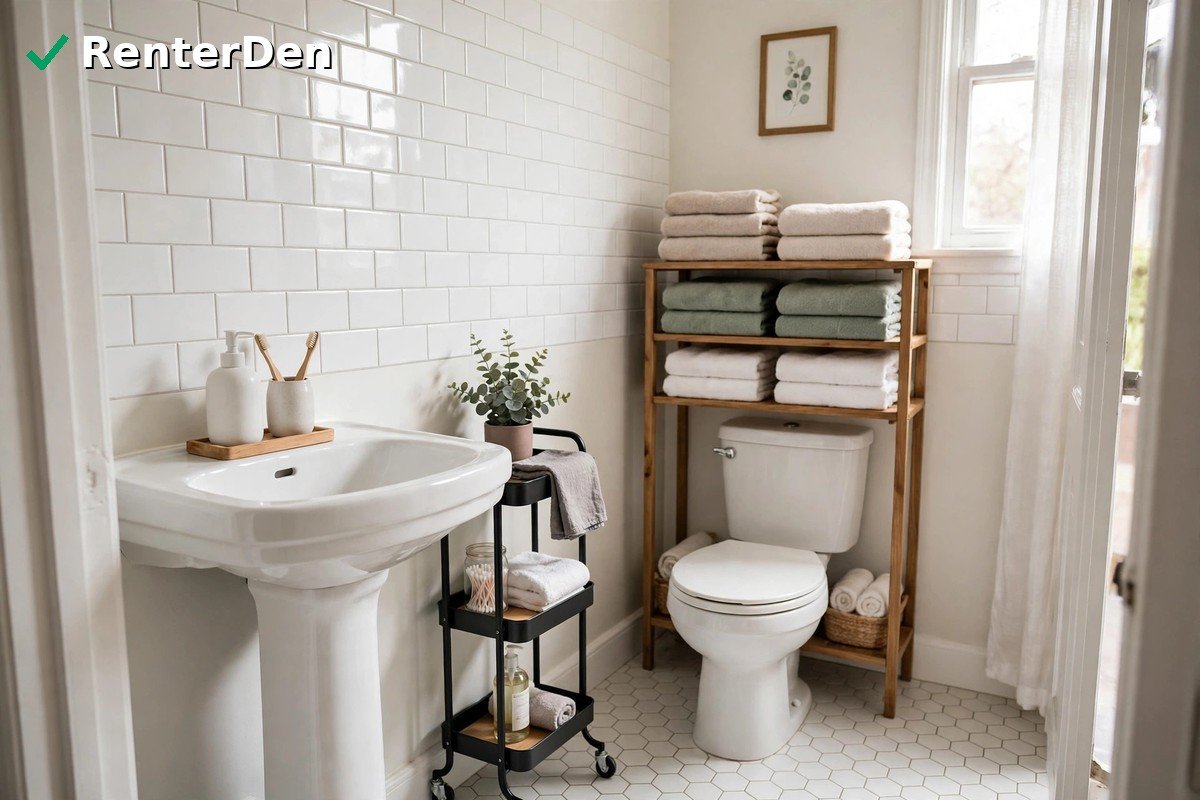
Pedestal Sink, No Storage? Fix It Without Drilling
Fastest safe fix: Use a small tray on the sink rim for daily items, add a freestanding over-toilet unit or a narrow rolling cart, and hang towels on over-door hooks. Measure first: sink width and depth, space around the pedestal base, door swing, and height above the toilet. Do not drill or buy a wrap-around unit before you check that it fits.
Why a Pedestal Sink Leaves You With Nowhere to Put Anything
A pedestal sink looks clean and open, which is why landlords like it in a small bathroom. The problem is what it does not have: no cabinet underneath, no counter beside the basin, and often no flat surface at all. Toothpaste, soap, and a hairbrush end up balanced on the rim, crowded onto the toilet tank, or piled on the floor.
Verdict: Easy • 5 minutes • Free • DIY.
Measure Before You Buy
Most pedestal storage fails because it was bought before anyone measured. A unit that looks perfect online can be too wide for the gap beside the pedestal or too deep for the door to close. Spend ten minutes measuring and you will avoid most returns.
Measure the sink width and depth, then the pedestal base where it meets the floor. A wrap-around shelf must fit around that base, not just around the bowl above it. Measure the clear space on each side, the distance to the toilet and tub, the door swing, and, for an over-toilet unit, the tank width and height above the tank. Leave room to lift the tank lid and reach the flush handle.
Also check weight limits and moisture. Suction holds best on smooth, clean tile, and poorly on textured tile or grout lines. In a humid bathroom it can loosen sooner.
Verdict: Difficulty: Easy • Time: About 10 minutes • Cost: Free • DIY or Pro: DIY
Start With the Sink Itself: A Tray or Small Caddy
A small, non-slip tray on the flat part of the rim can hold a soap dispenser, a toothbrush holder, and one or two daily items. If your rim is too narrow or curved, a small sink-top caddy beside the basin does the same job. Keep this zone strict — only what you use every morning and evening — and choose a tray that is easy to wipe clean, with a raised edge to stop bottles sliding off.
Verdict: Difficulty: Easy • Time: A few minutes • Cost: Typically low • DIY or Pro: DIY
Add a Freestanding Over-Toilet Unit
A freestanding over-toilet unit is often the most useful addition. It stands on the floor on either side of the toilet, so it needs no drilling or adhesive, and its shelves turn dead vertical space into storage for towels and toiletries you do not use every day. Check that it clears the tank lid and flush handle, stands level, and is not overloaded on top. Put heavy items low.
Verdict: Difficulty: Easy • Time: Typically under an hour to assemble • Cost: Typically moderate • DIY or Pro: DIY
Slide a Narrow Rolling Cart Beside the Pedestal
A narrow rolling cart is a good second piece because it is portable and easy to move for cleaning. Slide it beside the pedestal or between the sink and toilet, and use it for hair tools, cleaning supplies, or extra toiletries. Leave a little extra room to roll: a cart pushed hard against the pedestal will scrape it and trap moisture. Use a small bin for tiny items so they do not tip over.
Verdict: Difficulty: Easy • Time: A few minutes to assemble • Cost: Typically low to moderate • DIY or Pro: DIY
Use the Door and the Towel Bar You Already Have
Over-door hooks or a hanging organizer need no drilling and can hold towels, a robe, or a small caddy, freeing the sink area for items that need to be near the mirror. Check first that the hook clears the frame and lets the door close and latch fully. Do not overload the door, since heavy bottles can strain the hinges. For overflow such as spare towels, a closet and storage spot elsewhere in the apartment often works better than forcing everything into the bathroom.
Verdict: Difficulty: Easy • Time: A few minutes • Cost: Typically low • DIY or Pro: DIY
Try a Pedestal Wrap-Around Shelf — Only If the Measurements Match
A wrap-around shelf fits around the pedestal and uses the space under the basin. When it fits, it is neat and efficient. When it does not, it wobbles or presses against the pedestal and wall. Compare the product measurements with your own, not just with a photo, and check the opening, base width, and height under the basin. If the listing does not give the opening size, do not guess. A fabric sink skirt can hide floor storage, but make sure it does not trap moisture or hang where it will stay wet.
Verdict: Difficulty: Easy to moderate • Time: Typically under an hour • Cost: Typically low to moderate • DIY or Pro: DIY
Suction and Tension Storage: Useful, But Only in the Right Spot
Suction shelves and tension-pole caddies leave no holes, so they suit rentals. A suction shelf on smooth tile can hold a few light toiletries, and a tension caddy in a corner adds vertical storage without touching the wall permanently. Suction fails on textured tile, over grout lines, and on dusty or wet surfaces, and humidity can weaken the seal. Test it with light items for a day or two before trusting it with glass bottles, and check that a tension pole fits the measured gap.
Verdict: Difficulty: Easy • Time: A few minutes • Cost: Typically low • DIY or Pro: DIY
When It Does Not Fit / Fails
- Wrap-around unit does not fit: Do not trim, force, or wedge it. Return it if you can, and switch to a freestanding cart or over-toilet unit.
- Suction falls: Clean and dry a smooth tile area away from grout and reduce the load. If it falls again, stop using it for anything breakable or heavy.
- Freestanding unit wobbles: Check the floor is level, adjust the feet, and put heavy items low. If it still wobbles, move it or choose a wider, lower unit.
- Unit blocks toilet or towel access: Move it. You must reach the toilet, flush handle, and a towel without stretching around a shelf.
- Door will not close: Remove the over-door hook or move the cart out of the door swing.
If two renter-safe options fail in the same spot, the spot is the problem, not the product. Try a different wall or gap, or storage outside the bathroom.
Verdict: Easy • 10 minutes • Free • DIY.
The Last Resort: Drilled or Glued Storage
Drilled shelves and strong glued mounts can hold more weight, but in a rental that permanence is the problem. Drilling tile can crack it, leave holes that cost part of your deposit to repair, and break a lease rule. Adhesive can pull paint or tile glaze off when removed. Before considering either, read your lease, ask your landlord in writing if unsure, and keep the answer. Only proceed with clear permission, if you accept the possible repair cost, and if no renter-safe alternative works.
Verdict: Difficulty: Moderate to hard • Time: Typically an hour or more, plus repair time at move-out • Cost: Typically moderate, plus possible repair costs • DIY or Pro: Pro recommended if drilling tile
A Simple Setup That Works in Most Small Bathrooms
Start here: a small tray on the sink rim for daily items only, a freestanding over-toilet unit for towels and extras, a narrow rolling cart beside the pedestal if you have a clear gap, and towels on over-door hooks. Live with that setup for a week before buying anything else. For more ideas, browse the bathroom section, and if towels are piling up, a laundry routine that keeps towels moving can help as much as extra shelving.
Verdict: Difficulty: Easy • Time: Typically under an hour in total • Cost: Typically low to moderate • DIY or Pro: DIY
Frequently Asked Questions
Can I add storage to a pedestal sink without drilling? Yes. A sink tray, a freestanding over-toilet unit, a narrow rolling cart, over-door hooks, and a correctly fitted wrap-around shelf all work without drilling.
What should I measure before buying pedestal storage? Sink width and depth, pedestal base width, clear space on each side, door swing, and space above the toilet, including room to lift the tank lid. Also check weight limits and whether your tile is smooth or textured.
Why does my suction shelf keep falling? Suction usually fails on textured tile, over grout lines, or on a dusty or wet surface. Clean and dry a smooth area, reduce the load, and test with light items first. If it keeps falling, switch to a freestanding option.
Verdict: Easy • 30 minutes • Typically low • DIY.